Object number: T202612
Object Description: Light Car and Cyclecar article, 1923
Object Type: Publication
You may be used to certain things in your car coming as standard these days. Power steering and air conditioning; yes of course. Infotainment touch screen; perhaps. Front brakes? Well yes, surely they’ve always been a necessity?!
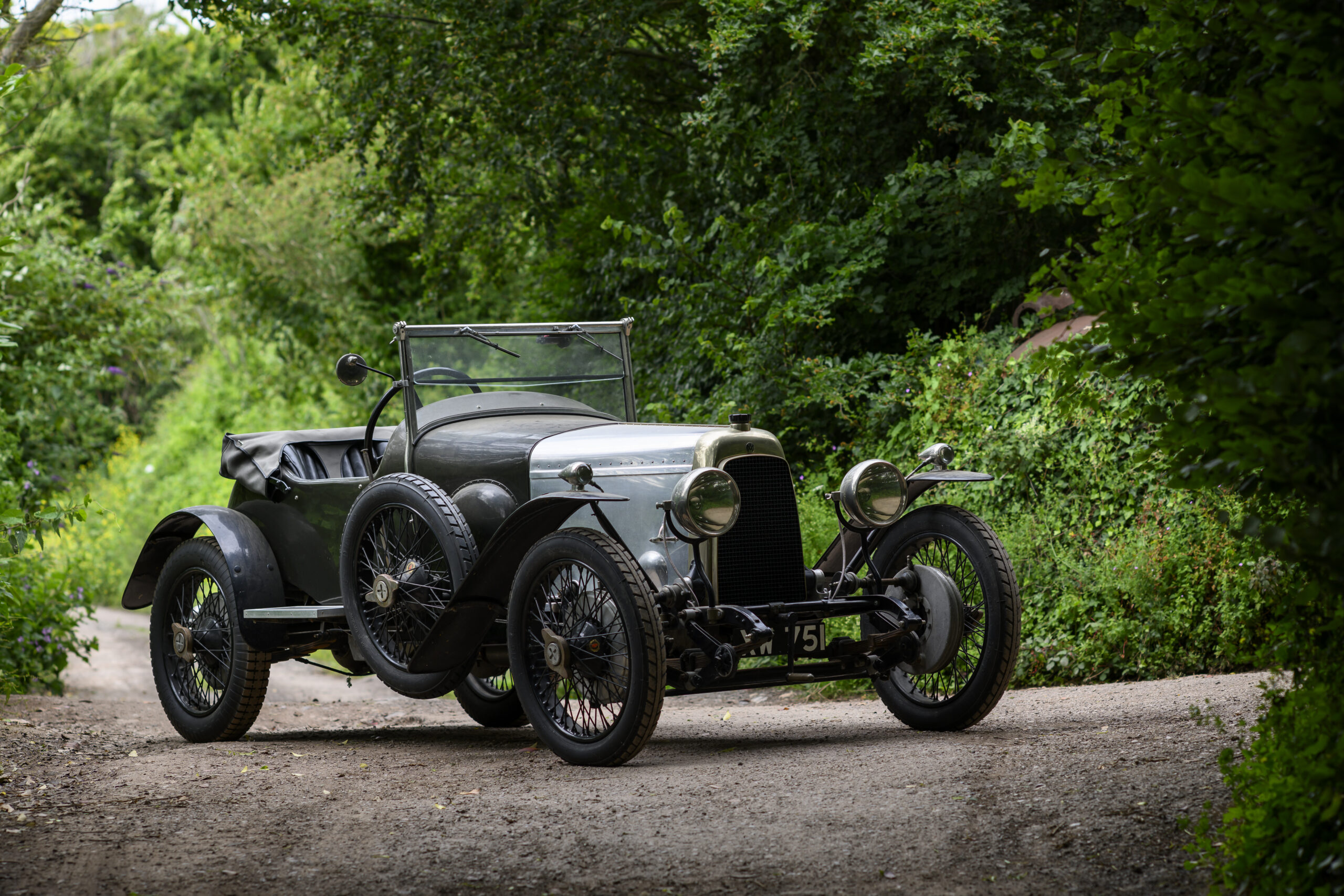
It might be a surprise to learn that early cars did not have any front brakes at all. They were often only fitted with back drum brakes. We have such a car in the Collection, chassis A3 built in 1921. Even though such cars were regularly raced, and in the case of A3 could reach speeds of up to 87 mph (140 kph), no front brakes were thought necessary. Perhaps car manufacturers were more interested in how to make a car go faster, rather than how to make it stop more easily!
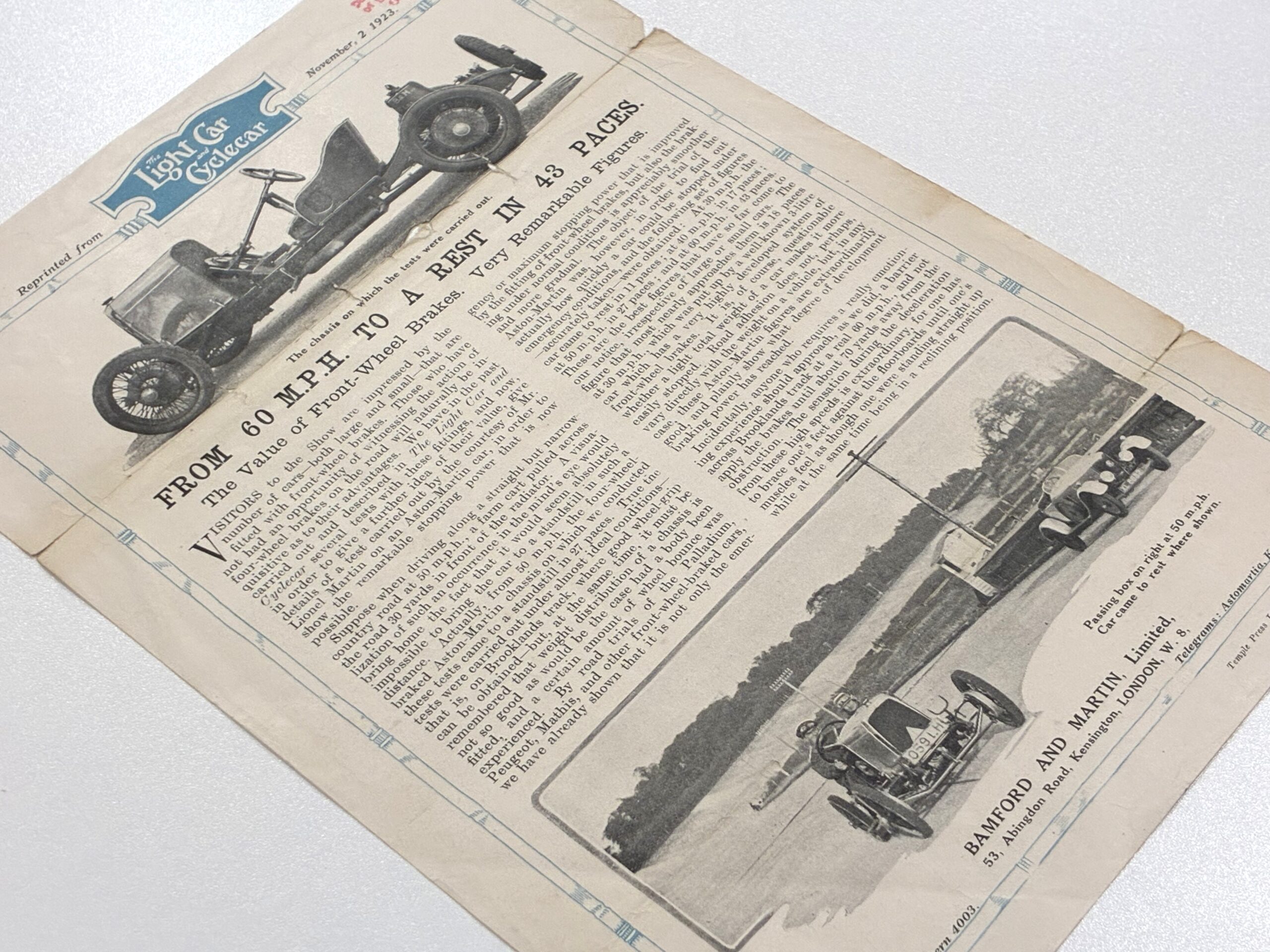
This month’s Object in Focus therefore caught my eye as something that to us may seem to be rather obvious, but at the time was relatively new and untested. It is a one-page magazine article reprinted from ‘The Light Car and Cyclecar’ magazine from 2nd November 1923. It has the main title “From 60 mph to a Rest in 43 Paces” and subtitle “The Value of Front-Wheel Brakes. Very Remarkable Figures”.

The car being tested around the Brooklands track was an early Aston-Martin car produced by Bamford and Martin Ltd and driven by Lionel Martin himself. Bamford and Martin Ltd was the first iteration of the company that we now know as Aston Martin Lagonda Ltd.

The aim of the test was to showcase “the remarkable stopping power” of having brakes on all four wheels and to find out exactly how quickly a car could be stopped under emergency conditions. The results were: At 30 mph, the car stopped in 11 paces. At 40 mph in 17 paces, at 50mph in 27 paces and at 60mph in 43 paces. These were apparently the best stopping figures the magazine had seen. A comparison is made to a “well-known” 3-litre car that had previously recorded 18 paces at 30 mph.
The final paragraph is particularly descriptive. “Incidentally, anyone who requires a really emotioning experience should approach, as we did, a barrier across Brooklands track at a real 60 mph, and not apply the brakes until about 70 yards away from the obstruction. The sensation during the deceleration from those high speeds is extraordinary, for one has to brace one’s feet against the floorboards until one’s muscles feel as though one were standing straight up while at the same time being in a reclining position”.
That image makes me rather thankful that braking technology has come a long way over the last 100 years or so!