Hands up who knew it was 65 years this year since that auspicious 1959 day when Aston Martin took their iconic Le Mans victory? 65 years and five days in fact.
Fresh off the back of this year's race, I thought it would be only right to make Le Mans the theme for this month's blog.
For those who aren’t so familiar with Le Mans; the 24 Heures du Mans, or 24 Hours of Le Mans, is a 24 hour endurance race that takes place annually on the Circuit de la Sarthe race track, close to the city of Le Mans in France.
It was first held as the Grand Prix of Endurance and Efficiency in 1923, organised by Automobile Club de l’Ouest. The race was held for car manufacturers wanting to test a vehicles durability, equipment and reliability.
Usually held in June every year, the race sees teams of three drivers take it in turns to compete in a maximum of four hours shifts, testing even the most experienced of professionals. For anyone that has seen Le Mans 66, with Matt Damon as Carroll Shelby, he has a fabulous quote about the danger and the thrill of taking part in this race.
There are now strict regulations, such as drivers not being allowed to total more than fourteen hours in the car, but it hasn’t always been this way. When Aston Martin won in 1959 there were only two drivers in the team and regulations were much more liberal.
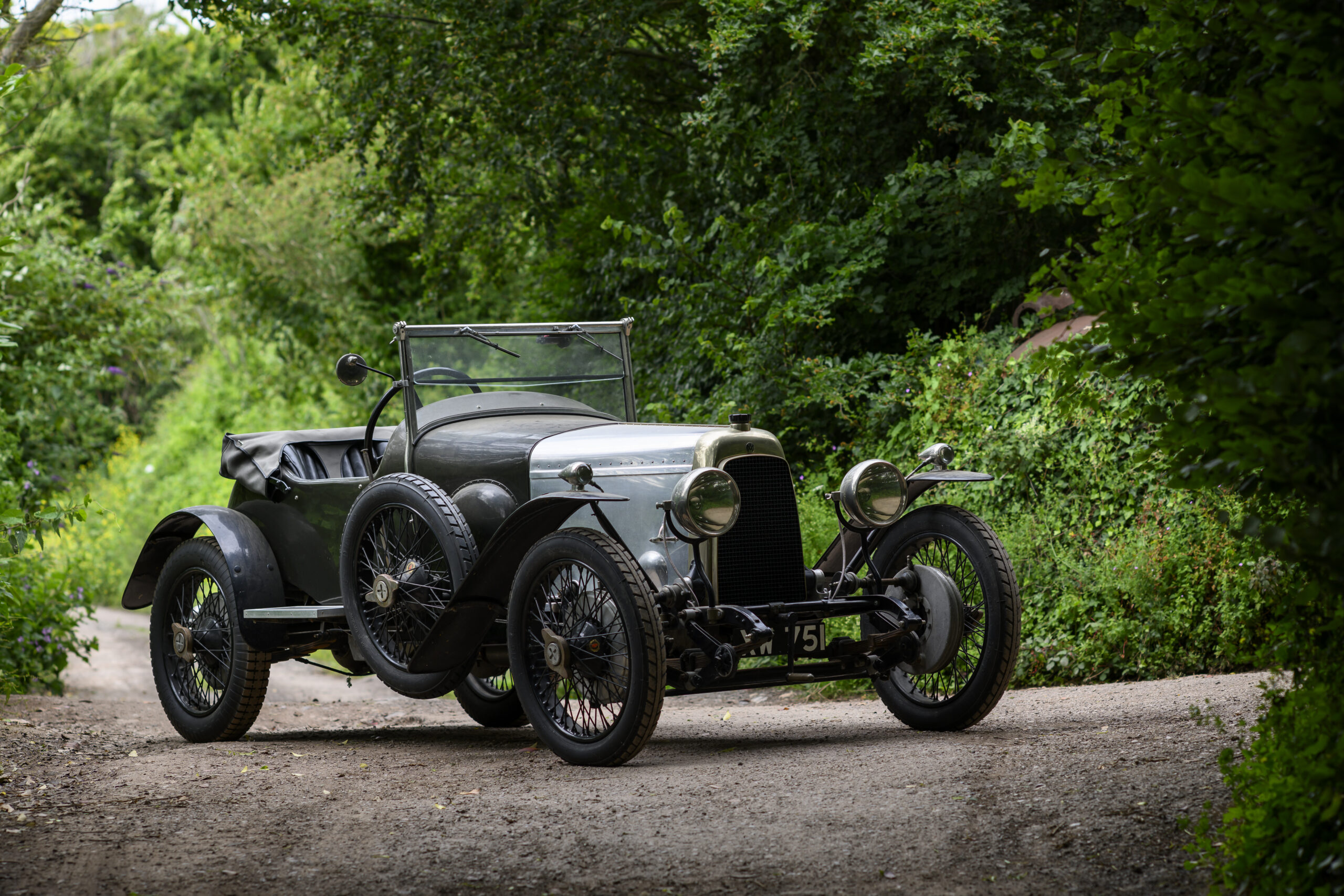
Aston Martin’s association with motor racing goes back to their earliest days and they first took part at Le Mans in 1928. Two new cars with original chassis were built in six months ready for this race. LM1 and LM2 were the first of 23 works team cars to emerge from the factory between 1928 and 1936.

But back to 1959.
On the 21 June, Carroll Shelby and Roy Salvadori drove Aston Martin DBR1/2 to victory.
Designed by Chief Engineer Ted Cutting, the DBR1 was an evolution of its predecessor, the DB3S. Following a change in regulations allowing non-road legal cars to race, Cutting was able to develop it in new directions. Originally fitted in 1956 with a 2.5 litre straight-six engine, by 1959 it featured a 2.9 litre unit rated at 250bhp.
Aston Martin entered three DBR1s in 1959. The DBR1 driven by Stirling Moss and Jack Fairman retired with engine trouble during the night. In the ultimate act of a team player, Moss had set out as a hare to draw the competing Ferrari’s into an unsustainable pace, a tactic which worked as cars began to drop out. As dawn broke the last Ferrari was three laps ahead of the two remaining DBR1s. Then, at 11am the Ferrari started to overheat and retired, leaving the two DBR1s to cross the finish line.
Incredibly, Carroll Shelby had been battling dysentery as well as holding a nitroglycerine capsule under his tongue in case of heart problems while driving, and his co-driver Roy Salvadori had driven for 14 hours while recovering from flu.


This wasn’t the only victory in 1959.
The World Sportscar Championship is made up of the toughest endurance races. In 1959 these were the 12 hour Florida International at Sebring, the Targa Florio in Sicily, the 1000km Nurburgring, the 24 Hours of Le Mans and the R.A.C. Tourist Trophy at Goodwood. A team’s three best finishes earned points.
David Brown ruled out mounting a challenge for the World Sportscar Championship, but sent a single DBR1 to Sebring. Driven by Roy Salvadori and Carroll Shelby, the car retired early on.
Aston Martin did not send a car to the Targa Florio, and had not intended to enter the Nurburgring 1000km either, until Stirling Moss persuaded them to let him drive a DBR1. He took the victory by 41 seconds. As we know, Aston Martin were victorious at Le Mans which left the final race of the R.A.C. Tourist Trophy at Goodwood.
Despite having to navigate some challenges, Moss had qualified in first and went on to win the race. This secured the 1959 World Sportscar Championship with the maximum possible points from the three wins.

We’re lucky to have some amazing items in the collection which are associated with Le Mans, and two in particular from 1959; the finishing flag and the World Sportscar Championship trophy. Both can be seen on display in the museum.
Aston Martin triumphed at Le Mans again in 2007 with a DBR9 (No. 009) in the GT1 class. It was driven to GT1 class victory and a fifth overall by David Brabham, Rickard Rydell and Darren Turner.

With the announcement last year that Aston Martin would be returning to Le Mans in 2025 with the Valkyrie, let’s see what happens!
Cover image: The Le Mans circuit at night, 14-15 June 1980